Significance tests
When to use it
A significance test relies on two hypotheses: the null hypothesis (H0) and the alternative hypothesis (Ha). It can be applied, for instance, to formally confirm if the average gaps found by two algorithms are statistically different. In such a case, H0 states that there are no differences between the average gaps, and Ha states the logical opposite, i.e., that there are differences between the average gaps.
A few tips
Building the distribution of the differences
Suppose the samples, namely the average gaps found by algorithms A and B, are a = [250, 500, …, 300], and b = [251, 480, …, 350], respectively. Then, the distribution of the differences is a - b = [-1, 20, …, -50].
Normality test
Depending on the type of test one wishes to perform, a normality test might be required. That is the case for parametric tests like the t-test. For nonparametric tests, such as the Wilcoxon signed-rank test, no assumptions are made on the samples, and the normality test is not necessary. The following diagram shows the type of test one must use based on a few characteristics of the data.
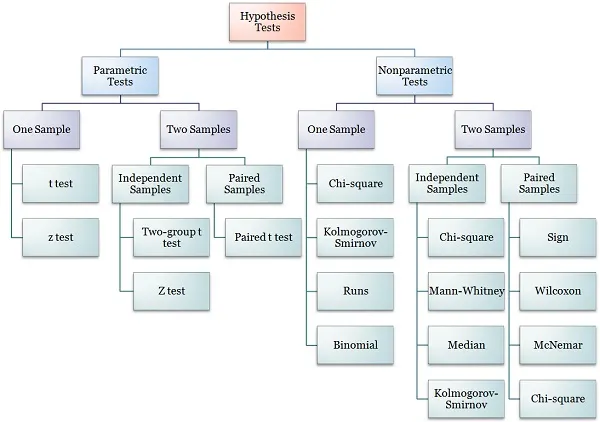
Although not strictly necessary, one can apply a normality test on a - b to confirm that it is not normally distributed and justify the choice of employing a nonparametric test.
Wilcoxon signed-rank test
The Wilcoxon signed-rank test can either reject the null hypothesis in favor of the alternative hypothesis, or fail to reject H0. The latter does not mean that the null hypothesis is accepted.